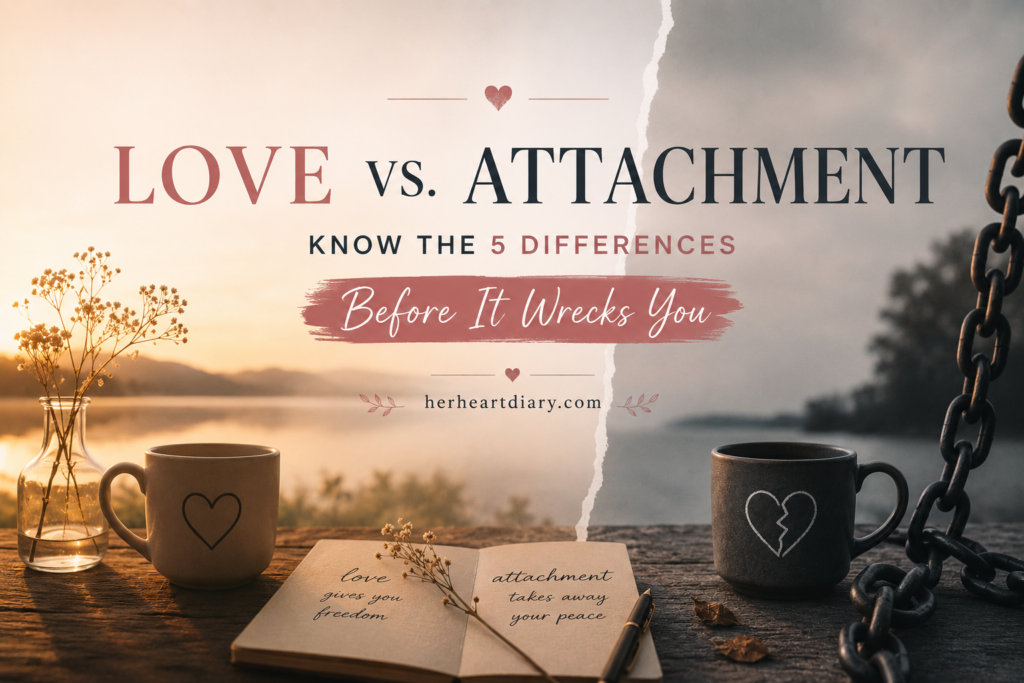
Love vs Attachment is something many people confuse in relationships. What feels like deep love can sometimes be emotional dependency, fear of losing someone, or unhealthy attachment. Understanding the difference can save you from emotional pain, anxiety, and toxic relationship patterns.
Here’s a truth rarely shared growing up — what you consider love could simply be attachment hiding behind a convincing facade. We use the word “love” so casually, like confetti. However, more often than not, what we truly feel is needed—desperation concealed in romantic guise.
And look, there’s no shame in that. Most of us learned love from people who confused it with control, possession, or fear of being alone. So we repeat the pattern without realizing it.
Once you really understand the difference between genuine love and emotional attachment, everything starts to change for the better. Your relationships become healthier, and your self-respect naturally boosts. You begin to let go of people who aren’t good for you, realizing that holding on tight isn’t worth the pain of letting go.
So let’s break this down — five real, honest points that separate love from attachment.
Table of Contents
1. Love Gives Freedom. Attachment Builds Cages.
When you genuinely love someone, you want to see them flourish. Sometimes, that means they might go down a path you didn’t expect, and that’s okay. You cheer for their independence, and their friendships and hobbies don’t cause you worries. It’s all about supporting each other’s growth and happiness.
Attachment? Completely opposite energy.
Attachment says, “Don’t go out tonight, stay with me.” Attachment checks their phone. Attachment feels personally attacked when they need space. It disguises control as care. It whispers, “If you loved me, you wouldn’t need anyone else.”
Real love trusts. It breathes. It doesn’t suffocate the other person with constant monitoring or guilt trips. You can miss someone without panicking. You can spend a weekend apart without spiralling into worst-case scenarios.
Freedom is the simplest test. If you can’t give it — or can’t handle receiving it — that’s attachment talking, not love.
If you’ve ever been cheated on, you know how deeply it can affect your confidence, trust, and emotional peace. Healing isn’t just about moving on — it’s about finding yourself again without losing your softness, self-worth, or ability to love. Read this guide on 5 powerful ways to heal after being cheated on without losing yourself.
2. Love Is Peaceful. Attachment Is Anxious.
Consider how your body feels around someone you care about. Does your nervous system relax? Do you feel safe and grounded?
Or does your stomach stay in knots? Are you constantly wondering where you stand? Do you replay conversations looking for hidden meanings? Does a late reply send your brain into overdrive?
Love brings a quiet kind of peace. Not the absence of problems — every relationship has those — but a baseline sense of security. You know where you stand. You don’t need constant reassurance to believe they care.
Attachment is often fueled by anxiety, thriving on uncertainty. Interestingly, the more unpredictable a relationship seems, the more we tend to call it ‘passionate.’ Sometimes, we confuse that rush of adrenaline with genuine emotion. However, that feeling is not truly love — it’s fear of losing someone dressed up as excitement.
Calm love might seem boring compared to the rollercoaster. But boring doesn’t destroy your mental health at 2 AM.
3. Love Accepts Imperfection. Attachment Idealizes.
When you’re really attached to someone, it’s easy to overlook the real person behind the image. You might imagine a perfect partner — someone who completes you and feels like the answer to loneliness. But if they don’t live up to that ideal, it can lead to feelings of resentment or even ignoring warning signs altogether.
Love sees clearly. It looks at someone’s flaws, their bad habits, their rough edges — and chooses them anyway. Not because they’re perfect, but because connection doesn’t require perfection.
Attached people often say things like, “They’re different from me” or “They’ll change eventually.” They cling to potential rather than reality and fall in love with a projection.
Loving people often say, “This is who they are right now. And I’m okay with that.” It’s about accepting each other without any savior complex or fantasized expectations. Just two imperfect humans choosing to be together with open eyes, embracing each other’s true selves.
4. Love Survives Distance. Attachment Crumbles Without Proximity.
This one hits hard for people in long-distance situations, but it applies to everyday life too.
If your sense of emotional balance relies heavily on someone’s physical presence, constant texting, or daily validation, that’s what we call attachment. It means you’ve come to see another person as your main source of emotional regulation. Without their support, you might feel like you’re falling apart.
Love holds steady across distance and silence. You carry the connection inside you. A week without talking doesn’t erase what you’ve built. You don’t need daily proof that the relationship exists because it lives in something deeper than just proximity.
Attachment reacts silently with panic; it interprets absence as abandonment and constantly seeks evidence to reassure itself that everything remains fine.
The truth is — if you can’t be okay alone, you can’t truly love someone else. You can only cling to them. And clinging eventually pushes people away, which confirms the fear that started the whole cycle.
According to Psychology Today, emotional attachment and genuine love affect mental well-being very differently.5. Love Lets Go When Necessary. Attachment Holds On Past the Expiry Date.
This is probably the hardest distinction of all.
Sometimes, love means knowing when to let go. It’s about understanding that staying together might be causing pain for both of you. Choosing someone’s happiness — including yours — over simply holding on to what’s familiar can be a truly caring decision.
Attachment cannot let go. It stays in dead relationships. It begs, bargains, manipulates. It would rather have a toxic connection than no connection at all. The thought of being alone feels worse than being mistreated.
You’ve likely observed this in others, or perhaps experienced it yourself. Staying with someone not because it feels right, but because leaving seems too hard, isn’t love — it’s fear. It’s the fear of the unknown, the fear of starting fresh, and the fear that no one else might want you. Remember, you’re not alone in this, and there is hope for a brighter, more confident you.
Real love respects endings. It grieves, yes. It hurts like hell. But it doesn’t chain itself to something that’s already gone just to avoid the pain of release.
Conclusion : Love vs Attachment Can Change Your Entire Relationship
Here’s a gentle reminder — many of us have felt that attachment and thought it was love. That’s completely human and nothing to be ashamed of. We all develop these patterns from a young age, and changing them is a journey that requires patience, honesty, and sometimes a tough but necessary look at ourselves.
But the awareness itself is powerful. Once you can name what you’re feeling — once you can pause and ask yourself, “Am I loving this person or am I just terrified of losing them?” — you start making different choices.
Love should truly enrich your life, making you feel more yourself, not less. It’s about expanding your world, not narrowing it down to just one person’s approval. When love is healthy and genuine, it brings growth and happiness into your life.
Select connections that truly feel like coming home — warm, comforting, and safe — rather than ones that make you feel like you’re teetering on the edge of a cliff, uncertain and scared.
That’s the key difference. And once you experience that feeling, you’ll never mix up the two again.