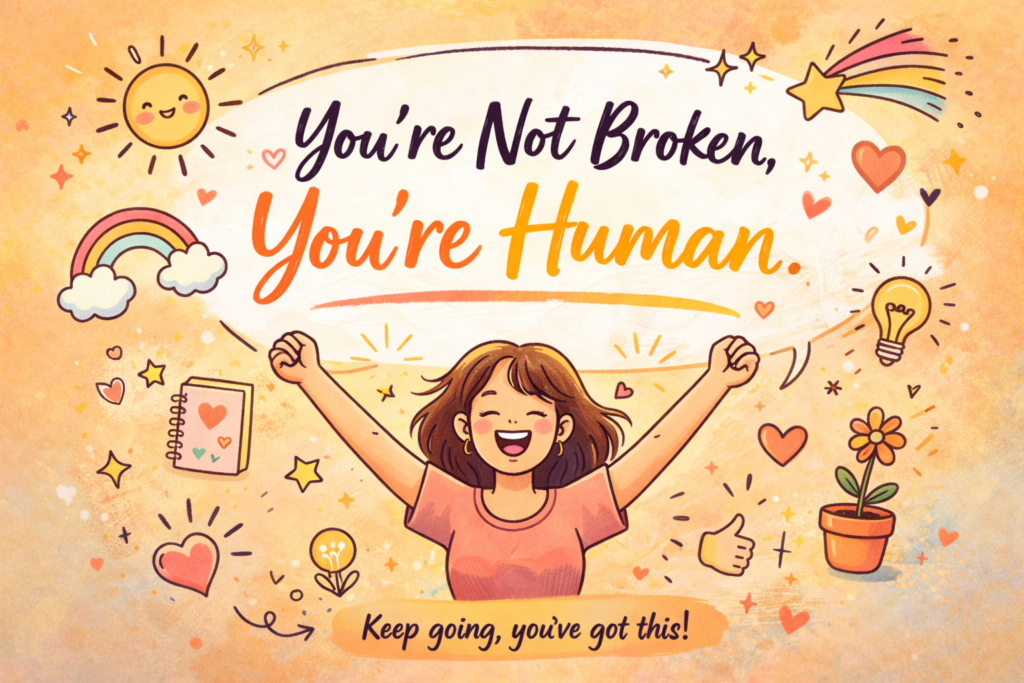

If you constantly feel not good enough, even when you’re trying your best, you’re not alone.
There’s a quiet voice inside that keeps telling you you’re lacking something… and over time, you start believing it.
Let’s be honest for a moment…: have you ever been alone at night, scrolling through your phone, observing other people’s lives, and suddenly felt a heavy weight on your chest? That quiet voice in your mind whispering, “Everyone is doing better than me. I am not good enough.” If so, you’re not broken. You’re not weak. You’re simply, wonderfully human.
This feeling — this stubborn belief that you are somehow less than others — is one of the most common emotional struggles people face today. And the worst part? Most of us never talk about it. We smile at work. We laugh with friends. We post pictures online. But inside, there is a constant courtroom running where we are both the accused and the judge, and the verdict is always guilty.
I have felt it. You have felt it. The person sitting next to you on the bus has probably felt it too.
The truth is, feeling “not good enough” rarely has anything to do with your actual worth. It has everything to do with where that belief came from, how it got planted inside you, and why your brain keeps watering it like a stubborn gardener who refuses to let a weed die.
So today, let us dig into this together. No fancy psychology jargon. No motivational poster nonsense. Just real, raw, honest conversation about why this feeling exists and what you can actually do about it.
Table of Contents
1. Childhood Programming That Never Got Updated
Here is something most people do not realize — the way you see yourself today was largely shaped before you even turned ten years old.
Think about that for a second.
When you were a child, your brain was like wet cement. Every comment, every reaction, every look from the adults around you left an imprint. If your parents constantly compare you to your cousin who got better grades, your brain recorded a simple message: “I am not as good as others.” If a teacher embarrassed you in front of the class for giving a wrong answer, your brain filed away: “Speaking up is dangerous. I will get it wrong.”
Think about a boy named Aarav.
His father wasn’t a bad man. He worked long hours, cared for his family, and genuinely wanted his son to succeed.
But every time Aarav brought home his report card, the moment always felt the same.
His father’s eyes would quickly scan past all the good marks…
and stop at the one subject where he scored less.
“What happened here?”
No smile. No “well done.”
Never a word about the seven subjects where he did well. Just that one finger, always pointing at the gap.
Just that one question—quiet, but heavy enough to stay.
Years passed.
Aarav is twenty-seven now.
He has built a decent life for himself. He achieves things people appreciate…
But inside, nothing really changed.
Every time he does something good, his mind skips the success…
and searches for what’s missing.
And then that same voice shows up—
“What happened here?”
It sounds like his father.
But now, it lives inside his own head.
Aarav doesn’t have a confidence problem.
He’s just running on an old pattern—one he learned too early, and never questioned.
And that is the thing about childhood programming — it does not come with an expiration date. It just keeps running in the background, eating up your energy, unless you consciously decide to notice it and rewrite it.
2. The Comparison Trap That Social Media Built
We all know social media is not real life. We have heard this a thousand times. And yet, knowing something and feeling something are two completely different animals.
Your logical brain says, “That Instagram post is curated, filtered, and carefully selected from two hundred attempts.” But your emotional brain — the part that actually controls how you feel — sees a person on a beach in Bali with perfect skin and a perfect partner and thinks, “Why is my life so boring? Why am I so average?”
Social media’s cruelty lies in showing thousands of successful people, not just one. During a scroll, you see someone your age with a house, lost weight, got married, started a business, or traveled. Your brain merges these into an unreal, superhuman image, then unfairly compares your chaotic life to this nonexistent ideal.
No wonder you feel like you are falling behind. You are racing against a ghost.
The damage is quiet but deep. You stop celebrating your own small wins because they look ridiculous compared to someone else’s highlight reel. You stop sharing your real feelings because vulnerability feels like weakness when everyone else seems to have it all figured out. You start measuring your worth in likes, followers, and external validation — and when those numbers do not rise, you take it personally, as if the algorithm is confirming what you always secretly feared.
“If this feeling is coming from constantly comparing yourself or doubting your worth, you might relate to this — read this here: A Woman Who Knows Her Worth Doesn’t Compete.“
You are not losing at life. You are just playing a rigged game and wondering why you cannot win.
3. Perfectionism Disguised as Ambition
Society loves perfectionists. We call them “driven.” We call them “high achievers.” We put them on stages and hand them awards and tell everyone else to be more like them.
But here is what nobody talks about — Perfectionism isn’t just about wanting to do well; it’s more intense. Wanting to do well can be expressed as, “I’ll try my best and learn from mistakes.” In contrast, perfectionism can feel like, “If it’s not flawless, I must be a failure, and everyone will see differences in me.”
Perfectionism is not a strength. It is fear wearing a suit and tie.
When you’re a perfectionist, nothing ever feels truly complete.
You finish a project, but instead of feeling proud, your mind instantly zooms in on that one paragraph you could have written better.
You cook a meal for your friends, and while everyone is laughing and enjoying themselves, you sit there quietly…
thinking about how the rice was slightly overcooked.
You get a promotion, something you worked so hard for…
but within days, the excitement fades, replaced by a quiet anxiety—
Do I really deserve this? What if they find out I’m not as good as they think?
No matter what you achieve, your mind finds a way to turn it into something that’s still not enough.
4. Surrounding Yourself With People Who Shrink You
This one is uncomfortable to talk about, but it matters more than almost anything else on this list.
Sometimes, the reason you feel not good enough is not because of some deep childhood wound or a social media addiction. Sometimes, it is because the people around you — right now, today — are actively making you feel small.
It is not always obvious. Toxic people are rarely movie villains who laugh and insult you to your face. More often, they are subtle. They are the friend who always has to one-up your story. The partner who makes “jokes” about your weight or intelligence and then says you are too sensitive when you react. The family member who asks pointed questions about your career or relationship status at every gathering, smiling the whole time, as if they are just being curious and not deliberately pressing on a bruise.
These people create an environment where you are constantly second-guessing yourself. You start editing your words before you speak them. You stop sharing your dreams because last time you did, someone laughed or changed the subject. You shrink yourself to fit inside the space they have decided you deserve.
Research also shows that constantly comparing yourself to others can increase feelings of inadequacy and anxiety.And the most painful part — sometimes these are people you love. Sometimes it is your own mother. Sometimes it is your best friend since childhood. And because you love them, you assume the problem must be you. “They would not say these things if I did not deserve it, right?”
Wrong.
You could be the most confident, grounded, emotionally strong person in the world…
but if you spend enough time around people who make you feel invisible, you will slowly start to disappear.
Not because you’re weak—
but because we’re human.
And humans absorb the energy of the people they stay close to, whether they realize it or not.
“Sometimes, these thoughts are actually subtle signs of low self-esteem that we don’t even notice. You can read more about it here: 5 Subtle Signs Your Self-Esteem Is Lower Than You Think. “
That’s why it’s so important to notice how you feel after spending time with someone.
Do you walk away feeling lighter, more like yourself…
or do you feel drained, small, and a little unsure of who you are?
Your body already knows the truth.
It always has.
You just have to stop ignoring it.
5. You Are Measuring Your Inside Against Everyone Else’s Outside
This is perhaps the most important point on this entire list, so please read it slowly.
You know every single ugly thing about yourself. Every failure. Every embarrassing moment. Every thought you are ashamed of. Every time you cried in the bathroom. Every time you pretended to be okay when you were falling apart. You have full, unfiltered, behind-the-scenes access to your own mess.
But when you look at other people, you only see the finished product. The confident smile. The polished LinkedIn profile. The easy laugh. The seemingly effortless success. You do not see their three a.m. anxiety attacks. You do not see the arguments with their partner, the credit card debt, the imposter syndrome, the quiet desperation they hide behind small talk.
So when you compare yourself to them, you are doing something fundamentally unfair — you are comparing your unedited director’s cut with their theatrical trailer. And trailers always look better than the full movie.
Every person you admire… every person you envy… every person you think has it all figured out—
they all have a version of this same voice in their head.
The CEO still questions herself before big meetings.
The fitness influencer has days when they can’t stand their own reflection.
And that “perfect” couple you see online?
They probably argued in the car just minutes before posting that smiling photo.
No one is as put together as they seem.
You’re not behind.
You’re not broken.
You’re just the only person who sees your life unfiltered—every doubt, every flaw, every insecure thought…
And you’re comparing that raw, honest version of yourself
to everyone else’s carefully edited highlights.
No one is meeting the standard you’re holding yourself to.
Not even the people you think are.
Conclusion
So, why do you feel not good enough?
Not because you are actually lacking something. But because life — through childhood, through culture, through relationships, through the ruthless machinery of comparison — has been feeding you a lie so consistently and for so long that it started to taste like truth.
That voice in your head that says you are too slow, too fat, too boring, too much, or not enough — that voice is not yours. It is a collage. It is your third-grade teacher, your distant parent, your cruel ex, your carefully curated Instagram feed, your impossible standards, all stitched together into something that sounds like you but is not you at all.
The real you isn’t that voice in your head.
The real you is the one who kept going despite that voice.
The one who showed up to work even on days when getting out of bed felt like climbing a mountain.
The one who kept loving people, even after being hurt.
The one who didn’t quit on life… even when it would have been easier to.
And right now—
the one who is reading this, searching for answers,
still trying, still hoping, still refusing to give up on themselves.
That is not the behavior of someone who isn’t good enough.
That is the quiet strength of someone who has always been enough…
and is finally starting to remember it.
You do not need to earn your worth. You were born with it. The work is not about becoming good enough — it is about unlearning every lie that made you forget you already were.
Start today. Unfollow one account that makes you feel bad. Set one boundary with someone who shrinks you. Write down one thing you did well this week — just one — and do not let that voice argue with you about it.
You are not a project that needs fixing. You are a person who needs reminding.
And consider this your reminder.✨
And if you’re on a journey of choosing yourself and building self-worth, you might also love reading this: How to Stop Being a People Pleaser (Before You Lose Yourself Completely).