
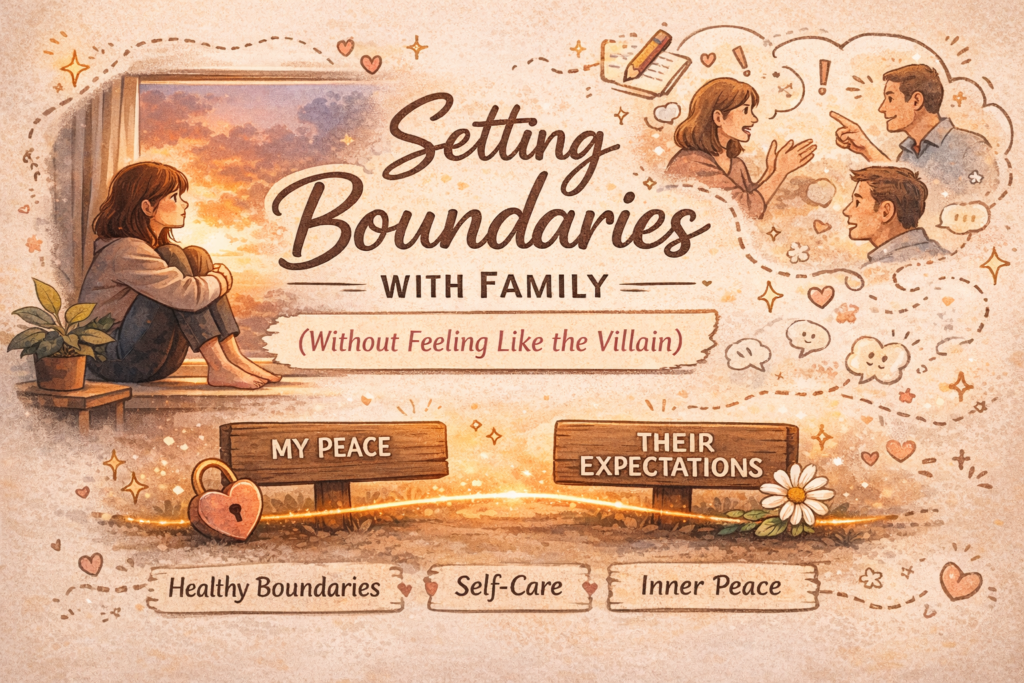
Learning how to set boundaries with family can feel one of the hardest things to do.
Let’s be honest – nobody really prepares you for the fact that the hardest conversations in your life won’t be with strangers or colleagues… they’ll be with the people who raised you, grew up with you, or share your last name.
With family, it’s never simply about words. It’s about emotions, memories, and expectations… and sometimes, there’s unspoken pressure that makes you feel like you owe them something, even if it costs your own peace.
Setting boundaries with family can feel uncomfortable at first — almost like you’re doing something wrong, something selfish… even ungrateful. You start questioning yourself: “Am I overreacting?” “What if they get hurt?” “What if this changes everything?”
And that guilt? It can be heavy.
Here’s a little insight I gained through experience — loving someone doesn’t mean you have to compromise your peace. It’s entirely possible to care deeply for your family and still prioritize yourself. Respecting them doesn’t mean sacrificing your mental and emotional health. If you’ve been finding this hard (like I have), remember, you’re not alone. It’s a tough journey, but an important one.
“If you also struggle with putting others before yourself, you might relate to this guide on how to stop being a people pleaser.”
Here are five things that actually helped me set boundaries with family — without feeling like the villain:
Table of Contents
1. Set Boundaries with Family by First Understanding What’s Bothering You
Before saying anything to anyone else — pause for a moment and sit with yourself. Honestly ask: “What exactly is bothering me?”
Because sometimes, we don’t even realize what’s draining us… we just feel tired, irritated, or emotionally exhausted around certain people.
Is it the unannounced visits from cousins when you’re already overwhelmed with work from home?
Is it those “casual” comments about your weight, looks, or life choices at every family function?
Is it the constant comparisons with someone who earns more, achieved more, or is simply “better” in their eyes?
Or maybe… it’s the way your feelings get dismissed, your time isn’t respected, or your “no” is never taken seriously.
The truth is — if you don’t clearly understand what’s hurting you, you’ll keep tolerating it… and slowly, it will start affecting your mental peace more than you realize.
You can’t draw a line if you don’t even know where it needs to go.
So take some time. Reflect. Be honest with yourself — without guilt, without judgment.
And if it helps, write it down. Put all those thoughts on paper… every small thing that makes you uncomfortable.
No one else needs to see it. This is just for YOU.
Because the clearer you are about your feelings… the easier it becomes to express them calmly and confidently later.
“You’re completely right in choosing peace over pressure, even if that pressure comes from family. Remember, prioritizing your well-being is always important — it's okay to put yourself first sometimes".2. Use “I” Statements Instead of Blame
There’s a MASSIVE difference between
“You always control everything” vs
“When decisions are made for me without asking what I want – I feel overwhelmed.”
The first one starts a war… The second one starts an actual conversation.
Because the moment you use “you always…” or “you never…”, the other person automatically goes into defense mode. They stop listening… and start proving you wrong.
But when you speak from your own feelings — without blaming — it feels softer, safer, and easier for them to actually hear you.
A friend of mine, Risha, kept clashing with her mother over career choices after graduation — every dinner turned into a debate about what she should do next. One day she simply said,
“Mom, I love that you care about me doing well in life — but when all of my choices get questioned every time we talk about work/career stuff… it makes me shut down instead of open up.”
Her mom went quiet for a minute… and then actually listened.
Not because Risha used perfect words or something — but because she didn’t attack or blame her mom for caring too much.
And that’s the key here — you’re not trying to win an argument… you’re trying to be understood.
It might feel unnatural at first, especially if you’re used to bottling things up or reacting emotionally… but with a little practice, it becomes easier. And trust me, it changes the entire tone of the conversation.
3. Start Small – You Don’t Need A Grand Speech
Boundaries don’t require a family meeting or a dramatic announcement like in Bollywood movies lol… You don’t have to sit everyone down and explain your entire life in one go.
Sometimes, it’s much simpler than that.
It can be as quiet as not answering calls during work hours…
Or saying, “Can we talk about something else, please?” when relatives start asking why you aren’t married yet…
Or even choosing to step away from a conversation that’s making you uncomfortable.
These small moments might feel insignificant at first — but they’re actually very powerful.
Because boundaries aren’t built in one big conversation… they’re built in small, consistent actions over time.
The truth is, you don’t need to explain everything every time. You don’t need to justify your choices again and again just to be understood.
Small, consistent actions teach people how to treat you far better than one explosive confrontation ever will.
And the more you practice these small boundaries… the more confident and natural it starts to feel.
“Understanding your emotions is the first step toward self-worth — something I’ve talked about in this blog as well.”
4. Expect Pushback (And Hold Your Ground Anyway)
Here’s the uncomfortable truth brozayyy… the people most bothered by your boundaries are usually the ones who benefited the most from you having none.
So yes — when you finally start setting limits, not everyone is going to like it.
You might hear things like, “You’ve changed…” or “You were different before!”
And honestly? That can hurt… especially when it comes from your own family.
But here’s what you need to remind yourself — change isn’t betrayal.
You’re not abandoning your family… you’re just refusing to abandon yourself.
And that’s a very important difference.
Take Rohan’s example… He moved to Delhi for work, but his family still expected daily video calls — almost like he never really left home. When he gently said that 3 times a week would work better for him, his dad didn’t speak to him for 2 weeks straight.
That silence? It could’ve easily made him feel guilty enough to go back to old patterns.
But Rohan didn’t cave in.
He held his ground — respectfully, without fighting or over-explaining. And eventually, his dad came around. In fact, their conversations became better, because now neither side felt forced or drained.
That’s the thing about boundaries — they might create temporary discomfort… but they build long-term respect.
So if there’s pushback, don’t panic. Don’t immediately undo your progress just to keep the peace.
Sometimes, holding your ground is the kindest thing you can do for yourself.
“According to mental health experts, setting healthy boundaries is essential for emotional well-being.”
5. Boundaries Are Not Walls – Revisit Them
A boundary isn’t a permanent verdict engraved in stone forever… It’s not something rigid that can never change.
Life changes. People change. Relationships evolve.
What felt necessary 6 months ago might feel too strict now… or maybe it needs to be even stronger than before.
And that’s okay.
Because boundaries aren’t meant to cut people off completely — they’re meant to create a healthier space between you and them.
That’s why it’s important to check in with yourself from time to time:
Am I feeling respected? Peaceful? Happy?
Or am I slowly slipping back into old patterns again… where I ignore my needs just to keep others comfortable?
If something doesn’t feel right anymore — adjust it.
If something is working — keep it.
There’s no “perfect” boundary… only what feels right for you in this moment.
And remember — setting boundaries doesn’t mean you love your family any less… it just means you’re finally learning to love yourself enough too.
“Setting boundaries doesn’t make you a bad person… it makes you someone who finally respects themselves.”Final Thoughts…
Setting boundaries with family isn’t about loving them any less — it’s about loving yourself enough not to shrink anymore.
And yes… it’s going to feel messy, awkward, and extremely uncomfortable sometimes.
Some conversations won’t go the way you planned… some might leave you overthinking everything at 3am, wondering if you did the right thing.
But here’s the truth — growth rarely feels comfortable.
The version of you on the other side of that discomfort?
Calmer. Lighter. More honest. More at peace.
That version is worth every difficult word you had to say.
So don’t wait for the “perfect moment” or the “perfect words”… they don’t exist.
Start where you are. Speak gently, but honestly.
One boundary at a time.
One step at a time.
One version of a stronger you… at a time.
And trust me — it gets easier. ✨
“Love doesn’t require you to lose yourself — the right people will learn to meet you where your boundaries are.”“And if you’re on a journey of choosing yourself, don’t miss this — Love Yourself First: 9 Painful Things That Happen If You Don’t.”