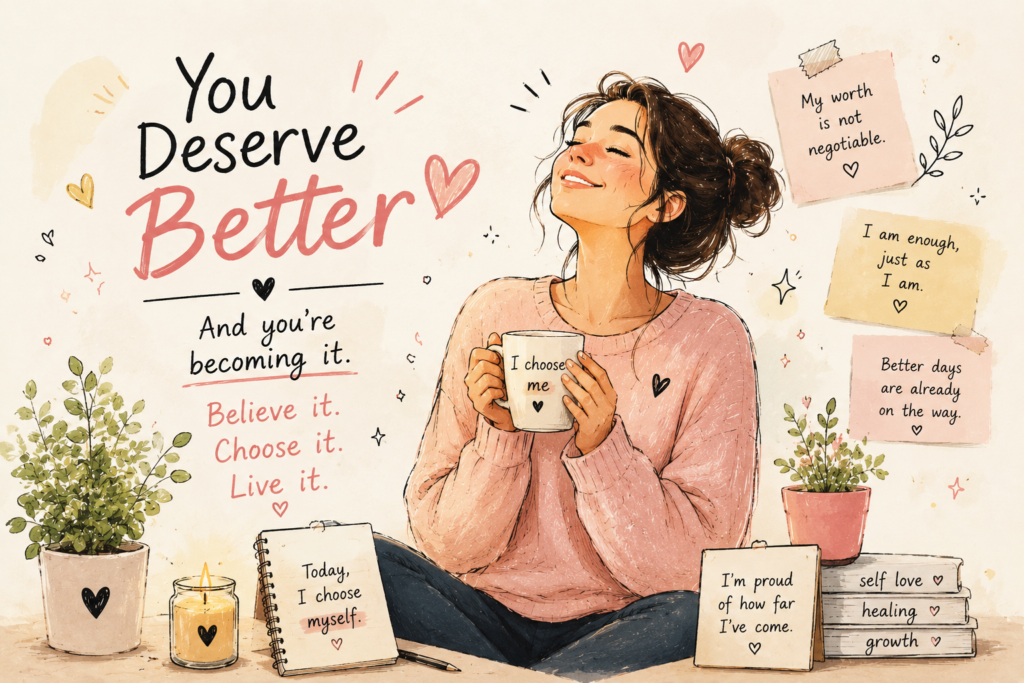
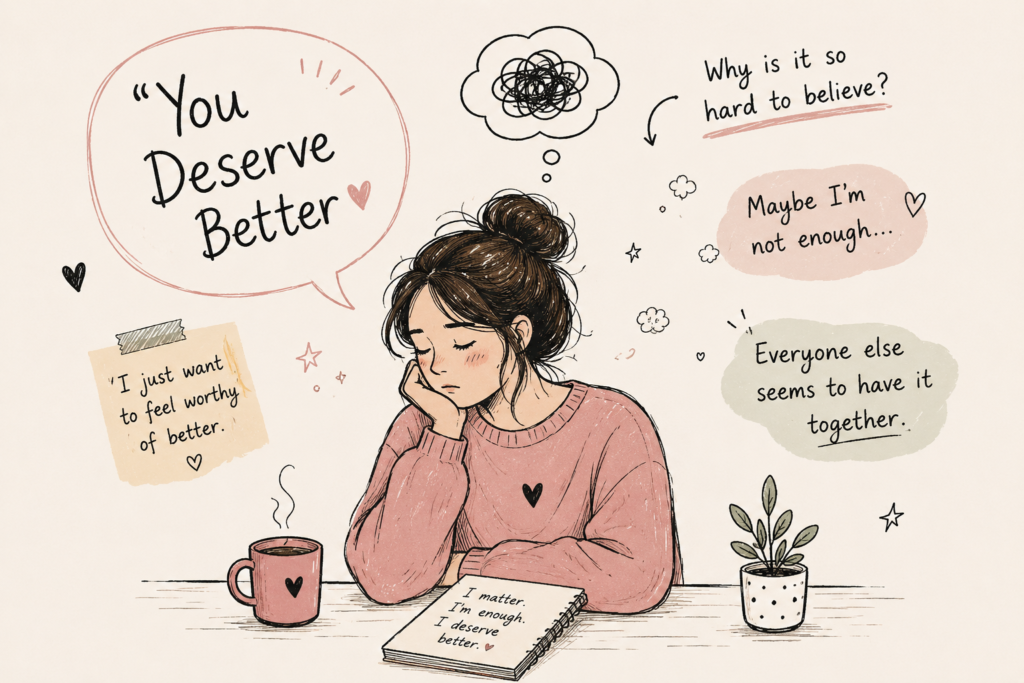
Someone gently tells you, “You deserve better.” Maybe it’s your best friend, maybe your mom, or even a stranger online who read your story and felt something tug at their heart. You nod softly and say, “Yeah, I know,” feeling seen and understood.
But sometimes, you might not fully see it. Not in the deepest, most genuine part of you—the quiet, messy, honest side that still goes over old texts at 2 AM and wonders what went wrong.
This phrase floats around so easily. People hand it out like free samples at a grocery store. But swallowing it? Actually digesting it and letting it change how you move through the world? That’s a completely different thing.
Let’s talk about why.
Table of Contents
1. You Were Taught to Earn Love, Not Expect It
Many of us were raised with similar lessons: to work hard, be good, and not ask for too much.
We often believe that love is something we need to earn — good grades bring praise, good behavior gets us affection. We tend to make ourselves small and easy to get along with, hoping others will stay.
So, when someone treats us unkindly, our first reaction isn’t anger but rather reflection: What did I do? Did I miss something? How can I make it better?
“You deserve better” encourages you to rethink your perspective. It gently reminds you that love isn’t something to earn, and you don’t need to prove yourself to receive it. Your very existence is valued and enough just as it is.
And honestly?
That can feel really scary. Because if love isn’t something you have to earn, then losing it doesn’t mean you did something wrong. Embracing this idea can be tough, but it also means accepting that sometimes, things just aren’t fair.
There’s no lesson to learn, no growth to be gained—just pain that perhaps didn’t need to happen. Remember, you’re not alone in feeling this way, and it’s okay to feel vulnerable about it.
That’s a hard pill without water.
“You don’t stop deserving better just because you got used to less.”
(If you constantly feel like you’re “not enough,” you may also relate to 👉 Why Do I Feel Not Good Enough? )
2. Your Brain Confuses Familiar with Safe
Here’s a little something to keep in mind: your nervous system isn’t good at telling the difference between feeling “comfortable” and what’s actually “good for you.” It simply responds to what it recognizes.
Growing up in chaos might make it feel familiar, and when someone keeps you guessing, uncertainty can seem like an intriguing journey.
If you had to struggle just to get a little attention, then genuine, easy love might feel a bit suspicious or unfamiliar. It might even seem boring or just wrong in some way, but that’s all part of how your past shapes what feels familiar to you.
When people say you deserve better, your body instinctively pushes back. ‘Better’ feels unfamiliar, like being in someone else’s house and wearing clothes that aren’t yours. You keep looking for a catch because you’ve always associated anything good with a hidden flaw.
This isn’t a sign of weakness. It’s about wiring, and rewiring requires more than just a single sentence from a well-meaning friend.
3. Believing It Means Admitting What You Accepted Wasn’t Okay
This is the one that really stings.
If you feel you deserve better, it might mean what you had was less than what you truly deserve. Staying in that situation could have been because it seemed familiar or comfortable at the time.
The years you spent trying, adjusting, shrinking, and hoping—weren’t about noble patience. Sometimes, it’s just you settling for crumbs and calling it a meal, and that’s okay to acknowledge.
Nobody prefers to view their own story in that light. It’s simpler to think, “It wasn’t that bad,” or “They had good moments too,” rather than confronting the full burden of what you endured.
Believing you deserve better allows your heart to grieve. It’s not just about missing the person, but also about mourning the version of yourself who stayed too long and wore a smile through it all. That version did their best with the knowledge they had, and recognizing this only deepens your understanding of your grief.
The most challenging aspect isn’t hearing ‘you deserve better’—it’s overcoming every moment that made you believe otherwise.
4. The People Who Say It Often Don’t Show You What “Better” Looks Like
“You deserve better” is vague. It’s a direction without a map.
Better how? Better where? Better with whom? What does better even feel like on a Tuesday night when you’re eating dinner alone and the apartment is too quiet?
When you’ve only experienced a single pattern, the idea of “better” remains abstract. It exists only in films and others’ Instagram captions. You can’t pursue something you’ve never encountered, nor can you trust promises that lack form.
This is why the phrase alone is never enough. People need proof. They need one interaction, one relationship, one moment that shows them—oh. This is what it feels like when someone chooses you without conditions.
This is what respect tastes like in daily life. Not grand gestures. Just consistent, boring, beautiful safety.
Until you experience that, “you deserve better” is just words bouncing off a wall you built to survive.
5. Deep Down, You’re Afraid That “Better” Won’t Want You Back
Let’s be brutally honest for a second.
Sometimes, you might find it hard to believe you deserve better because you’re worried that ‘better’ will simply look at you and say, ‘Ohh..No thanks.’ You might also fear that the love you truly desire will notice your baggage, patterns, and wounds and then walk away.
Remember, everyone deserves love and understanding, especially from themselves.
So you stay where you are. At least here, someone chose you. Even if they chose you badly. Even if their love felt more like a leash than a gift. At least you weren’t alone.
This fear is incredibly common and touches everyone—men, women, teenagers, and those in their forties beginning anew. It’s a feeling we all share: the desire for something beautiful and the heartbreaking experience of being told we can’t have it.
But here’s what nobody mentions: you don’t have to believe you deserve better all at once. You just have to act like it once. Then once more. Then again. Belief catches up eventually. It’s slow. It’s annoying. But it moves.
If you’ve spent years doubting your worth in relationships, reading books like How To Be The Love You Seek can help you understand why emotional pain affects self-worth so deeply — and how healing slowly becomes possible. 👉 You can check the book here.
Conclusion
“You deserve better” is not a magic spell. Hearing it won’t fix your self-worth overnight. It won’t undo years of learning that your value depends on someone else’s mood.
But it plants something—a tiny, persistent seed resting quietly in the dirt for a while, doing nothing obvious. And then, one day—perhaps after therapy, maybe after a breakdown, or maybe after someone finally shows you genuine kindness—you might find yourself bursting into tears because you forgot that was even possible. And then, it grows.
You don’t need to believe it right now. Just gently stop arguing with it. Allow it to be there, take up space, and become familiar.
Over time, one morning, you might wake up and think: ‘Yeah, actually, I do.’ Then, you can move forward with that understanding.
Healing begins the moment you stop settling for less than you deserve. And if you’re still learning self-worth, 👉 Love Yourself First may help you understand why it matters so deeply.